

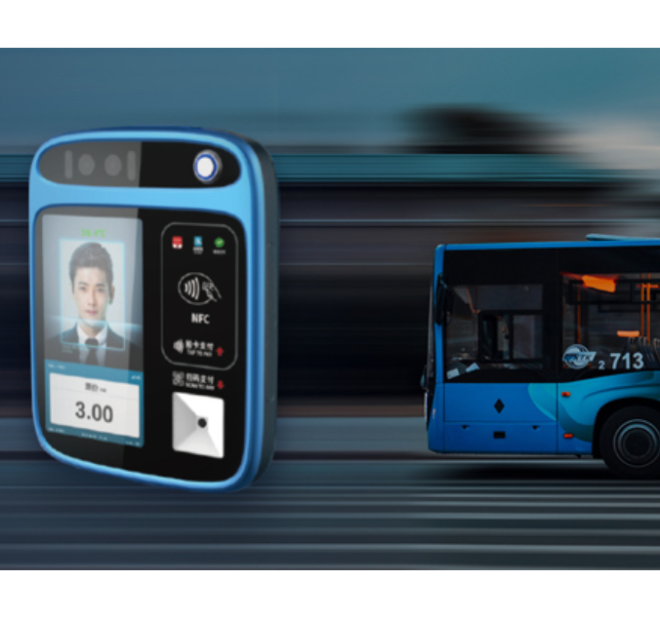

The Bus Face Payment Machine
In the context of the epidemic prevention and control era, new demands such as contactless and insensitive passing have accelerated the application of face recognition gates, and the application fields have been further expanded. According to the research of Golong Technology, the shipment scale of face recognition gates reached 410,000 in 2020, an increase of 50.2% year-on-year, which has become another major growth point and profit point for smart campuses, smart transportation, smart communities, and other industries.
Facial recognition gate machines account for 62% of the applications in buildings and campuses. Compared with IC cards, app/QR codes, fingerprints, and other recognition methods, face recognition gates are safe and convenient with high recognition accuracy and better experience, and have gradually become the mainstream application.
- Current application scenarios can be divided in three main categories:
- Subways, trains, high-speed railways, bus stations, airports, supermarkets, etc.
- Office buildings, parks, factories, attractions, parks, playgrounds, schools, etc.
- Government, banks, exhibition halls, and so on.
According to the survey, the face recognition gates have the widest application in buildings, parks, and other fields, accounting for 62%. Railway accounts for 15%, and scenic spots, parks, and entertainment venues account for 23%.
In terms of product functions, face recognition gates were used more in traffic scenarios such as bus stations, docks, train stations, and airports to meet the needs of real-name authentication and identity verification. With the rapid development of artificial intelligence, big data, the Internet of Things, and other technologies, and the continuous maturity of face recognition technology in practical applications, face recognition gates have incorporated more functions such as attendance, payment, and temperature measurement, and some new application scenarios have also been continuously developed.
In 2020, due to the need to prevent and control the epidemic, facial recognition and temperature measurement began to be widely used in communities, scenic spots, and other densely populated areas. In addition, the face recognition gates also have functions such as attendance, verification of tickets at scenic spots, parks, and other places, and public transport payment.
In 2020, the number of face recognition gateway shipments increased by more than 50% year-on-year, while the year-on-year increase in 2019 was only 14%. There is a very close relationship with contactless face recognition in 2020.
The AI temperature measurement system combines a large infrared thermal imager with face recognition technology. The detection screen can display people’s temperature map 10 meters away without machine contact or manual intervention. It can operate continuously for 24 hours. Once it detects abnormal temperature, the face can be remembered by the system. There are many similar contactless applications, such as AI temperature measurement on buses, facial recognition and temperature measurement machines in hospitals, buildings, and scenic spots, all-in-one access control and intelligent lifts in parks and campuses, and so on.
Golong Technology believes that the face recognition gate is not a short-term product. It will be widely used in hospitals, border inspection, and prevention and control of major activities in the post-pandemic era and beyond. At the same time, the global trend of intelligence is also a major opportunity for the further commercialization of face recognition gates. Through the continuous enrichment of intelligent services and the expansion of more diversified innovative applications, face recognition gates will become the standard product for intelligent development in various industries.