

Deputy Director of Hangzhou Public Transportation Strategic Development Institute, Luo Xuqi - "Smart Public Transportation Hangzhou Model"
Hangzhou Bus, as a traditional enterprise, operates over 10,000 buses with 25,000 employees, covering an area of more than 8,000 square kilometers. As a labor-intensive transportation industry, how should we proceed? In recent years, Hangzhou Public Transportation has accelerated the construction of smart public transportation, deeply promoting the application of big data in various fields of operation and services. Today, taking this opportunity, I will report on the current progress in Hangzhou. Considering the extensive content of the Hangzhou model, I will focus on two main areas.
Operational Intelligence
Operational intelligence management includes four aspects: passenger flow, route network, scheduling, and safety. The first two aspects revolve around how to operate the routes, while the latter two focus on how to manage them. Whether using traditional methods or modern technologies like the internet and big data, these two core issues remain central.
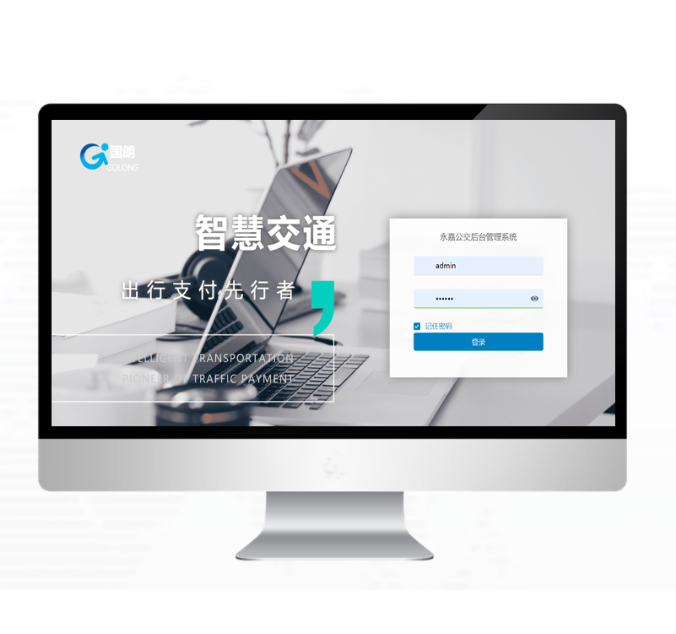
Passenger Flow Analysis Platform: Algorithm Models and Product Applications
Clustering Algorithms:Used for travel OD (origin-destination), transaction OD, user profiling, and regional heat calculation
Employ density clustering:Grid clustering, and distance clustering methods
Travel Chain:Methodology for studying passenger travel behavior
Identify travel purposes: distinguish passenger travel statuses, and analyze capacity and demand.
Transaction Matching:Identify vehicle information, station information, trip information, and time information for each passenger transaction.
User Profiling:Compile important characteristics and data of users to empower algorithms.
- Passenger Flow Analysis
- Real-time passenger flow
- Passenger flow issue rankings
- Route analysis
- Station analysis
- Capacity and passenger flow analysis
- Route OD analysis
- Detailed passenger flow export
- Citywide real-time passenger flow
Real-time passenger flow for routes
Passenger Flow Analysis Algorithm Model of Hangzhou Bus Data Brain
1、Passenger Flow
In 2017, we started developing and applying a passenger flow analysis platform to more accurately grasp the traffic flow and passenger flow on routes. The platform's function is straightforward: understanding the number of people at stations and on routes, where they are going, and whether our capacity matches their needs. If not, we adjust accordingly. This cycle repeats to ensure optimization.
For instance, analyzing the passenger distribution at each station and route, both for ascending and descending passengers, as well as categorizing passengers.
Daily Passenger Flow Analysis: Precisely grasping the spatial-temporal dynamics of city bus passenger flow.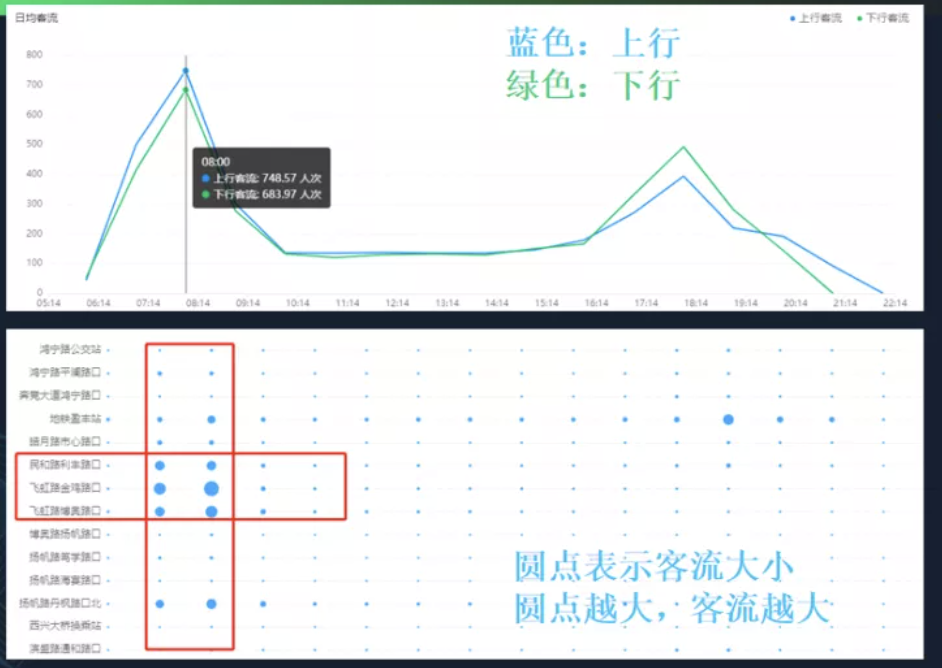
Using route 402 as an example, the first chart shows the passenger flow for both directions in ten-minute intervals, indicating directional and temporal balance. The second chart shows the passenger flow at each station in ten-minute intervals, providing insight into boarding patterns at various times.
Feature Introduction - Route and Station Passenger Flow Analysis
Route 402's daily passenger flow trend in ten-minute intervals reveals peak times and passenger numbers.
Route 402's daily station passenger flow trend in ten-minute intervals highlights peak passenger flow at each station.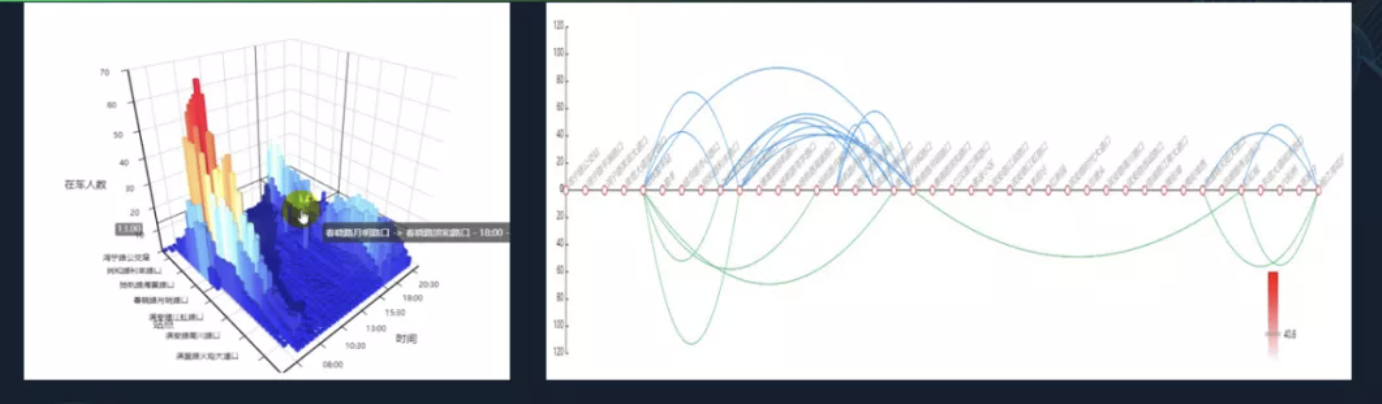
Feature Introduction - Route OD Analysis:
Analysis of passengers traveling from Hongning Road bus stop to Qianjiang Bay Garden on route 402 shows up to 70 passengers at the Yangfan Road and Danfeng Road intersection, potentially causing passenger loss and impacting experience. The fly line chart suggests the main demand is in the first half of the route, recommending additional peak interval buses to meet this demand.
Passenger Flow Issue Analysis: Synchronizing passenger flow and capacity.Analyze Passenger Flow and Capacity Configuration, and Optimize Train Operations Plan.
Normal Routes:Optimizable Routes
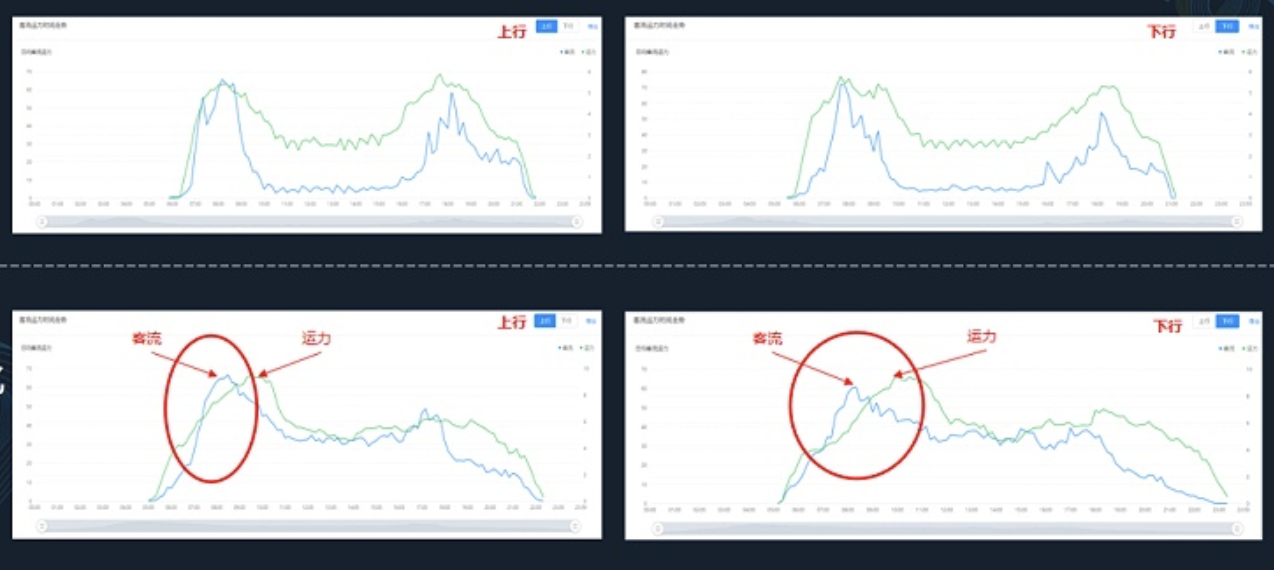
Analyzing whether the passenger flow and capacity configuration are synchronized helps optimize the train operations plan (as shown in the images). The top two images represent normal lines where capacity and passenger flow peak synchronously in both directions. The bottom two images show optimizable lines where capacity lags behind passenger flow in both directions. The platform provides suggestions to increase trips during peak periods in the train schedule.
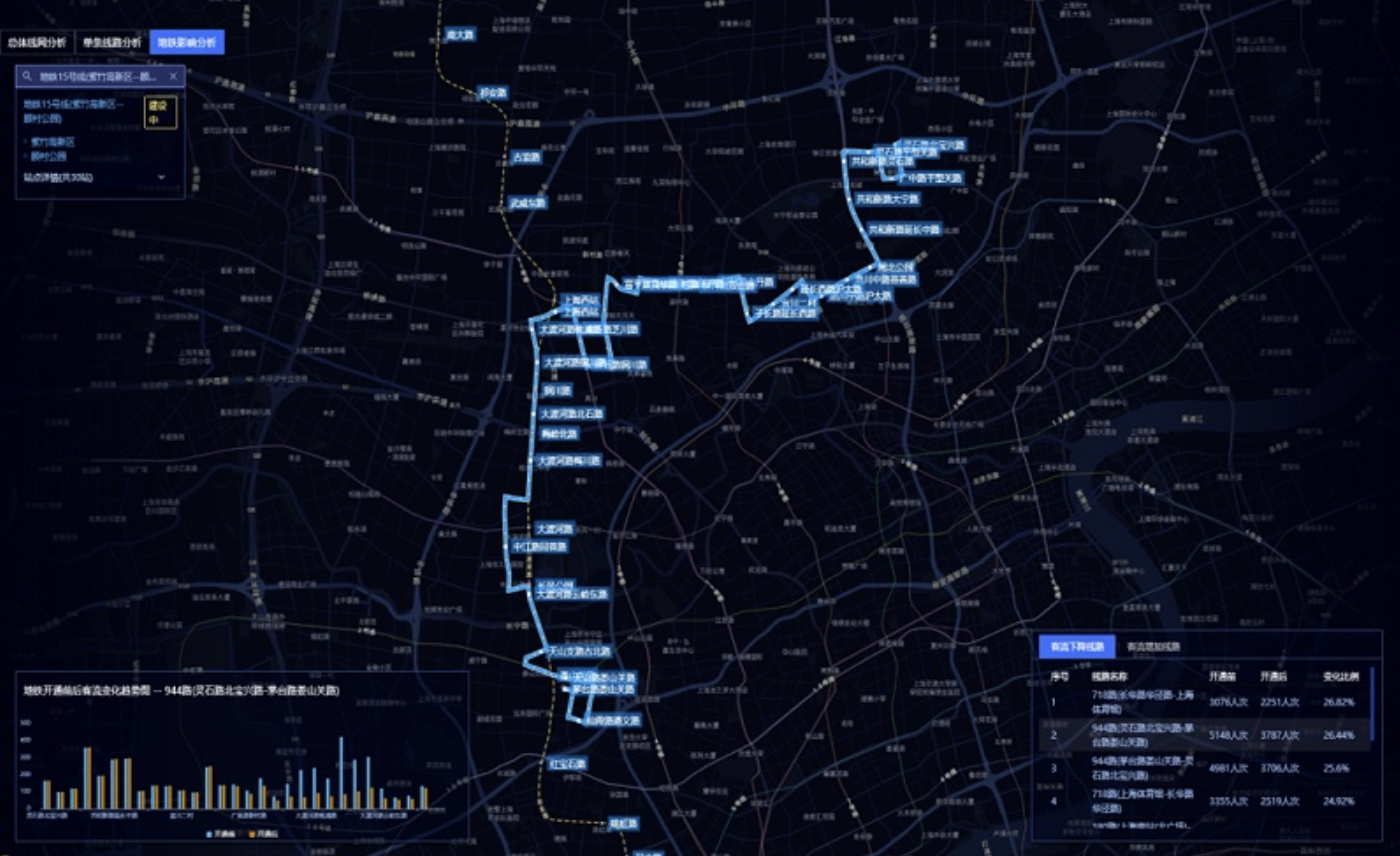
Network
- First, we need to understand where people are coming from and where they need to go
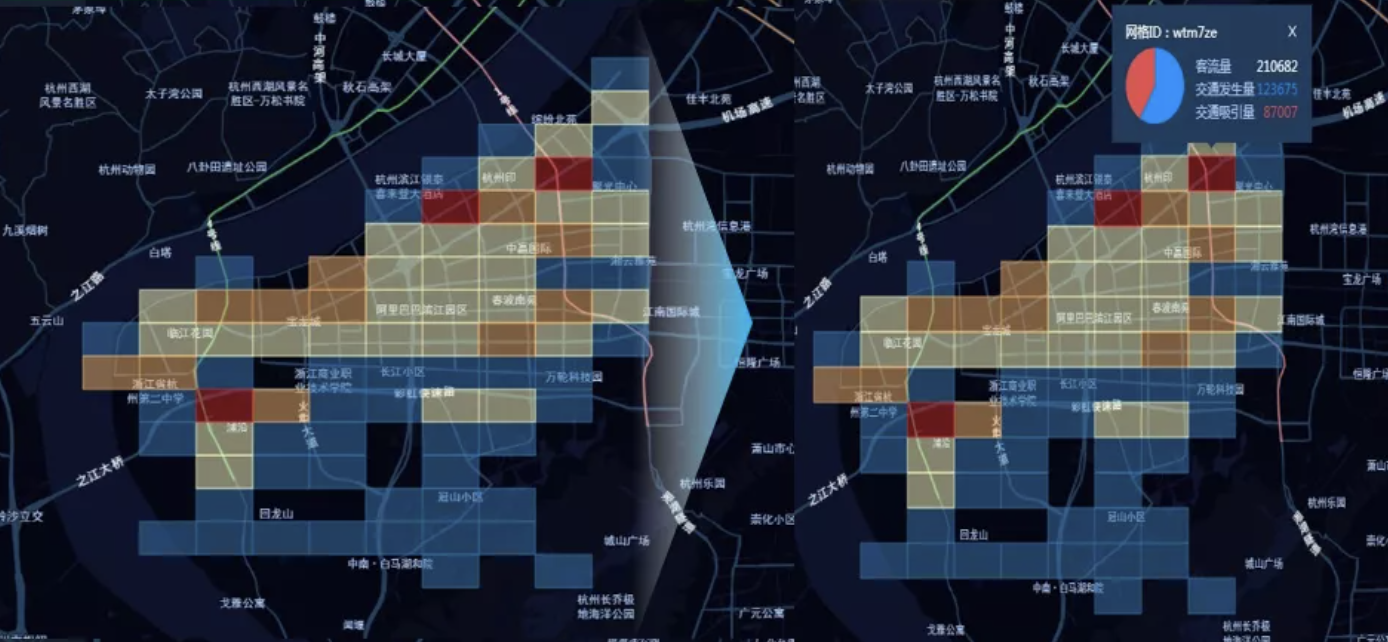
Next, we use the network management platform in combination with the passenger flow platform to support network planning and route optimization - Platform Value—Regional Route Adjustment、IoT-enabled Travel ODAnalyze Area、Analyze resident travel characteristics
- Identify main travel directions of residents
- Find areas with travel demand not covered by public transportation
- Identify areas where public transport service capacity does not meet travel demand
Integrate the data from multiple resources
- Adjust Routes
- Determine new routes and stops
- Adjust old strategies
- Data on intersections, POIs, stations, and road conditions
- Set operating times for new routes
- Develop vehicle deployment plans based on departure intervals and travel time.
- Setting Route Vehicle Deployment
- Calculate the number of vehicles allocated to a route based on departure intervals and one-way travel time
- Historical GPS data, departure intervals
Route passenger flow forecast evaluation
Conduct advanced forecast evaluations of route passenger flows based on comprehensive data and optimal travel path strategy algorithms.
This platform primarily focuses on optimizing and adjusting the network of routes, conducting corresponding analyses and evaluations on aspects such as route operating times, vehicle allocation plans, and passenger flow forecasts.
Bus Network Planning Platform、Massive data.
- Industry data
- Internet travel data
- Urban road network data
- Cloud Computing
- Alibaba Cloud's capabilities in billion-level big data computing
- Large-scale parallel computing clusters
- SAAS-based services
- Algorithms:Travel chain mining algorithm
- Passenger OD model
- Road network model, capacity model, vehicle speed model
- Passenger flow forecast and load simulation
- Customer Value:Innovative smart bus solutions
- Help solve business pain points
- Data support for decision-making assistance:During the process, the first step is to address the basic data management of the network, which is the most fundamental issue.
- Bus Network Planning Platform - Data Visualization
- Comprehensive display of network distribution
- Comprehensive display of vehicles
- Statistical analysis: station coverage, network indicators, speed analysis, and capacity analysis
The above bus network planning platform was one of the platforms built from early 2017. At that time, our entire system was named Bus Data Brain.
Different adjustment schemes can be set using the route adjustment tool, and passenger flow forecasts can be made. After the forecasts are completed, the analysis indicators of these schemes can be compared, and the most ideal implementation scheme can be selected based on the actual experience of operation and management personnel.
After the route plan is formulated, it is often unknown whether the effects of the plan after implementation will meet expectations and whether they will meet residents' travel needs. Are the formulated operation plans reasonable? Faced with these questions, simulation of route operations is conducted to make predictions.
The bus network planning platform has played an important role in promoting the integration of bus and subway networks. For example, before the opening of Metro Line 5, the platform accurately analyzed the fluctuation of passenger flows at subway stations along the line, identified the affected bus routes, and pinpointed the affected bus stops.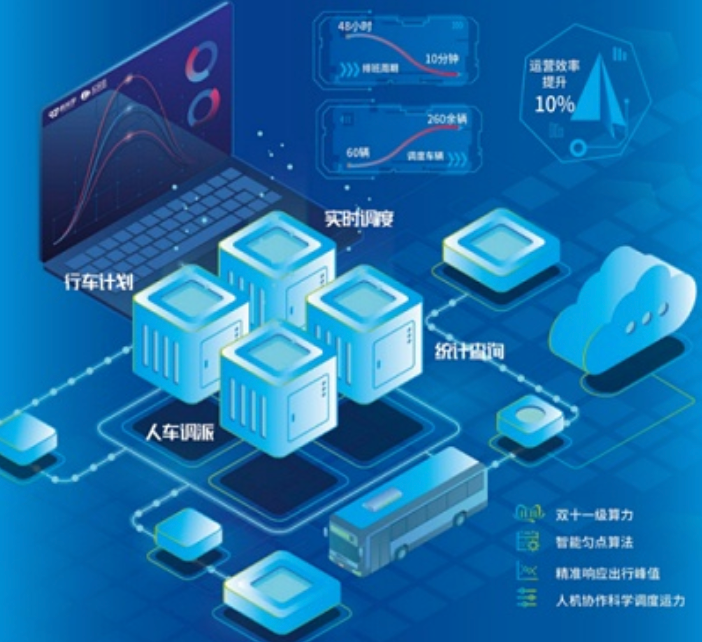
Scheduling
- Intelligent scheduling and automatic planning to achieve high matching of capacity and passenger flow
- Intelligent scheduling based on abnormal event handling
- Automatic planning based on passenger flow model
Driving plan
- Personnel and vehicle dispatch
- Real-time scheduling
- Statistical inquiry
- Generate reports
- Achieve high matching of capacity and passenger flow
- Reduce ineffective vehicle mileage
- Increase vehicle occupancy rates
- Enhance operational management efficiency
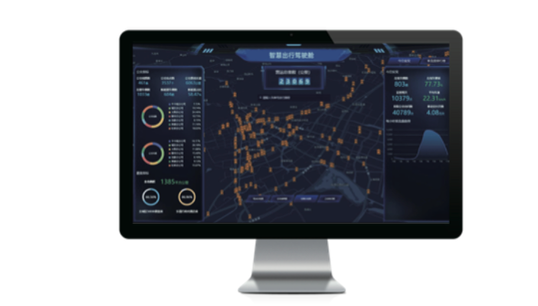
- Scientific scheduling has always been a key focus of Hangzhou's public bus operation management. We rely on our subsidiary investment unit, Bus Cloud Company, to build a cloud scheduling system. We strive to achieve more comprehensive and perfect planning and scheduling functions. Currently, it is being piloted on some routes in Hangzhou, and full coverage of routes is planned to be achieved by the end of this year.
Safety
- Safety management is an important part of operational management. Striving to achieve the city's model of "the safest public bus" is the goal of Hangzhou's public bus work. Safety management covers all aspects of driver, vehicle, station, and route management based on a dual-prevention management system.
- Dual prevention system
- Mobile safety management
- Risk traceability
- Driver:Fault vehicle networking
- Violation management
- Accident management
- Driving analysis:Electronic driver's license
- Safety training:Learning knowledge related to safety
- Electronic driver's license
- Vehicle:Face recognition
- Anti-collision warning
- Emergency recording
- Station:Access management
- Alcohol test attendance
- Information release
- Key management
- Routes:Speed limit

Road risk points,Passenger Smart Service
The previous section introduced how operational management is managed, which is more concerned by everyone. Now I'm going to talk about what we do facing passengers, in simple terms, to let passengers enjoy the results of enterprise intelligent applications.
1、Convenient Payment
Hangzhou Public Transport was the first in the industry to introduce mobile payment, with one of its goals being to better serve passengers, making it more convenient and affordable for them to pay for their tickets. In fact, the aim was also broader. After the pilot of mobile payment was launched in 2016, all fields of transportation have fully adopted it over nearly two years of development.
- Integrated Mobile Payment New Model
- Enhance the appeal and share rate of public transportation
- QR code mobile payment
- Ride code linked with health code
- Integrated mobile payment platform
- Ticketing linked with new retail discounts for rides
- Real-time bus electronic signboard
2、Customized Services
Leveraging data for innovative applications, Hangzhou has introduced a diversified service model. To improve the quality of passenger travel and meet diverse travel needs, service models are continuously innovated. On the basis of regular routes, various types of special routes have been opened.
- "Enjoyment Bus" based on the Hangzhou Public Transport travel app interface, providing customized special route services for passengers' travel needs.
- "Heartbeat Bus" based on subway plus bus travel, meeting the commuting needs of company employees within a 1-15 kilometer radius of subway stations.
- "Knowledge Line" for student travel between residential areas and schools, providing special route services for student pick-up and drop-off needs.
- "Orange Warm Bus" for passenger travel between large transportation hubs and travel areas, offering special route services for night connections at East Railway Station and special connections during epidemic prevention periods.
- "Digital Tourism Route" based on tourism services, providing special route services combining stops and scenic spots.
- "Park Customized Route" for commuting in large parks, offering special route services for commuting needs in various parks.
- Customized Service Grid Management
3、Information Sharing
Ensuring passengers can more accurately and conveniently access travel service information is a key guarantee for providing convenient services. The main ways applied in various cities are the public transport app and electronic signage. Taking electronic signage as an example, the design idea of the electronic signage built by Hangzhou Public Transport is to make it "urban furniture." Therefore, we designed different styles based on the characteristics of Hangzhou city, such as the West Lake Scenic Area, urban commercial areas, Qianjiang New City, and community buses. These incorporate public transport, subway, public bicycle, and other public transportation information services, along with taxi, passenger transport, railway, civil aviation, and other travel information services.
They also feature bilingual switching and one-click assistance functions, with a total of 10 comprehensive functions and 2 humanized services.