

Bus & Internet leverages aggregation payments in the construction field
Where there's payment, there's a realm. And within this realm, blood and storms are quite common. In the field of transportation payments, with the advent of NFC, QR codes, and other payment technologies, more and more competitors have entered, not only including the Ministry of Housing and Urban-Rural Development, the Ministry of Transport, and UnionPay, but also Internet giants such as Alipay, Tencent, and others have joined the mobile payment war in the transportation field with their "bus e-codes".
Recently, the Smart Payment Branch of the China Urban Public Transportation Association (hereinafter referred to as the "Smart Payment Branch") was officially established in Beijing, seemingly adding another faction to the already complex and factionalized realm of transportation payments. However, what arouses curiosity is that the star-studded lineup of the Smart Payment Branch includes internet payment giants such as Tencent, Ant Group, and Kuaiqian. Is the appearance of the Smart Payment Branch aimed at dominating the realm of transportation payments? Or will it bring about an even bigger storm? Recently, Mobile Payment Network interviewed Ma Hong, the Director of the Smart Payment Branch and the Director of the IC Card Application Service Center of the Ministry of Housing and Urban-Rural Development. In addition to discussing the development direction and goals of the Smart Payment Branch, Ma Hong proposed new viewpoints on the development of aggregation payments in the field of public transportation.
Rational competition is needed in the payment marketAs a second-level branch under the China Urban Public Transportation Association, the lineup of the Smart Payment Branch can be described as luxurious. It was jointly established by the IC Card Application Service Center of the Ministry of Housing and Urban-Rural Development and the National Smart Standardization Committee. It has brought together leading figures in Internet payment such as Tencent, Ant Group, Kuaiqian, major urban public transportation card operators, card issuers, chip manufacturers, system terminals, and related research institutions, with resources from hundreds of urban public transportation enterprises.
Before the entry of UnionPay and Internet payment giants, card issuers of transportation cards held absolute dominance and discourse power in the field of public transportation payments. Even telecom operators with hundreds of millions of users had to obtain permission from transportation card issuers to enter this field. However, since QR codes entered the field of transportation payments last year, it has not only broken the portal view that QR codes are not suitable for high-frequency and high-speed application scenarios but also overturned the traditional interest pattern, cutting off a portion of the benefits of transportation card issuers. For example, in the e-code projects launched in cities like Zhaoqing, payment companies directly cooperate with public transportation operators, bypassing transportation card issuers.
Ma Hong pointed out that the payment market requires aggregation, so appropriate competition must exist. As a guiding unit of the industry, the Smart Payment Branch hopes that strong competitors such as Tencent, Ant Group, and Wanda will participate and conduct rational competition. Regardless of the payment application and model, the ultimate choice should be left to consumers.
Building a top-notch aggregation payment platform
QR code payment has developed rapidly in the public transportation market. According to incomplete statistics from the Mobile Payment Network, in less than two years, nearly 30 cities' public buses and subways have supported QR code. The main bodies issuing codes and operating them include Internet payment companies, public transportation companies, and transportation card operators. However, they currently face the problem of inability to recognize each other's e-codes across cities, meaning that when arriving in a new city, one needs to download a new electronic public transportation card, or even different mobile apps if the public transportation or subway operators are different. Therefore, for people traveling across regions, a unified platform and standardization are needed to achieve data interaction between different places. Ma Hong introduced that the Smart Payment Branch is actually aiming to be a transfer platform that can uniformly recognize different e-codes.
Ma Hong introduced that the Smart Payment Branch is currently working on top-level design planning. In addition to hoping everyone understands the problems with issuing various codes, they also hope everyone realizes how to share scenes because everyone has demands besides public transportation. Public transportation is just a lever. Bus can leverage other scenes in the construction field. The value of a good transfer platform is infinite.
Value space of bus & InternetThe rapid penetration of Internet technology into the field of public transportation has made the market more open, which is both a challenge and an opportunity for traditional enterprises in the industry chain. For local applications in cities, Ma Hong believes that they are better at providing localized and precise services and are more familiar with and skilled in the construction of local scene applications. They are also more likely to connect with other types of local service enterprises, so the prospects for proactive changes by traditional enterprises are very promising.
One aspect is fan customization services brought by big data. Ma Hong pointed out that traditional industries are not only about traditional dispatching and travel but also need to focus on people from a long-term perspective. Now, more value-added services should be customized based on personal characteristics through Internet platforms, making consumers increasingly lazy and comfortable, and increasing their dependence and stickiness to customized services.
Another aspect is the value space of Internet finance. Ma Hong stated that payment is actually a tool, behind which is a financial concept. Payment tools mainly enable richer Internet of Things applications through payments in various industries. For example, the construction of a credit system enables free bus rides. The entry of insurance and financial services allows individuals to experience more types of financial services after taking public transportation, and even the use of funds.
Offline vs. online, who is the future?There is currently much controversy over whether the public transportation industry should adopt offline or online transactions. Public transportation cards have always used offline transaction models, but with the rise of emerging payment technologies, online transaction models have gradually entered buses and subways. Especially with mobile payment represented by UnionPay QuickPass, most of them are online transactions, and some cities' bus e-code projects are also piloting online transactions. Some believe that offline technology is backward and has certain difficulties in aspects such as blacklisting and reporting loss, and online transactions are the way forward. Others believe that reading data online will slow down transactions and is not suitable for transportation. With hundreds of cities' public transportation payment systems facing upgrades, whether to choose offline or online transactions is a key issue.
In this regard, Ma Hong believes that with the development of the Internet to this day, online technology has undergone earth-shaking changes. With the advent of the 4G and 5G eras, as long as it can meet the travel characteristics of public transportation, such as adapting to the requirements of dense crowds and fast passage, online transactions are possible. Especially as public transportation cards transition from anonymous to real-name, the online mode can capture the information of each individual, so the online mode is not impossible.
However, most cities still use a dual offline mode. Ma Hong introduced that some cities have explored single offline mode before, but the effect was not very good. The main reasons are that it is indeed necessary to meet the requirements of fast passage in densely populated areas, and because there are some blind spots in the online mode during passage, which cannot be solved by an Internet company alone. It belongs to the construction of network infrastructure, so the current main mode is still dual offline mode.

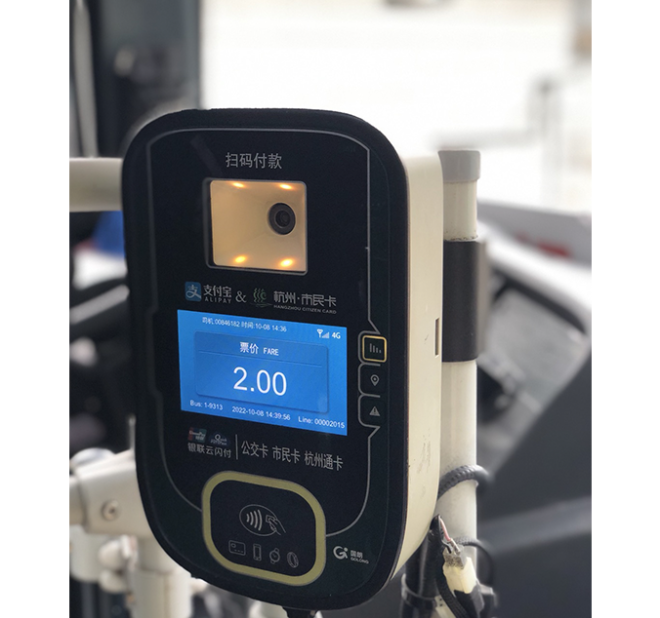
Regarding Director Ma Hong's new viewpoints on the development of aggregation payments in the field of public transportation, Hangzhou Golong Technology Co., Ltd. has comprehensively utilized advanced technologies such as computers, communications, electronics, and the Internet to establish a complete solution for current public transportation operations and public transportation Internet payments. The Golong bus POS machine has been officially launched and operated in Hangzhou, Wuhan, Chongqing, and other places, realizing mobile full payment for bus & the Internet, bringing real convenience to travel!